 Skip to content
You’re not alone. Millions of Pakistani households replace their janamaz every year not because they want to, but because low-quality materials wear out fast. A 2024 consumer survey by Daraz.pk found that 68% of buyers regret their prayer rug purchase within six months, citing poor stitching, thin pile, and color bleeding as the top complaints.
The market is flooded with options — from roadside stalls in Anarkali Bazaar to Amazon-style listings on Daraz, PakMarkaz, and OLX. The price range is staggering: Rs. 350 to Rs. 8,500 for a single janamaz. But price alone doesn’t tell you what you need to know.
In this guide, you’ll learn exactly what separates a prayer rug that lasts five years from one that lasts five months. We’re comparing materials, weave quality, design authenticity, and value for money — so you can make one smart purchase instead of five frustrated ones.
What Makes a High-Quality Prayer Rug in Pakistan?
The quality of a prayer rug comes down to three core factors: material integrity, pile density, and base construction. A premium prayer rug Pakistan buyers should look for will have a pile height of at least 8–12 mm, a jute or anti-slip latex backing, and colorfast dyes that survive machine washing.
Think of pile density like thread count in bed sheets — the higher it is, the softer and more durable the rug. Budget rugs typically use hollow-fiber polyester with a density under 100,000 knots per square meter. High-end velvet and wool rugs sit between 250,000 and 500,000 knots — and you can feel the difference under your forehead during sujood immediately.
A useful test: press your thumb into the rug’s pile and release. On a quality rug, the fibers spring back within two seconds. On a low-density rug, they stay matted.
Expert Insight: Textile engineers at the National Textile University Faisalabad (NTU) recommend checking the backing before the front. A rug’s longevity is determined more by its base weave than its surface pile.
Which Prayer Rug Material Is Best for Daily Use?
Not all prayer rug materials perform equally over time — and choosing wrong means replacing your janamaz every season.
Here’s how the main materials compare for daily use in Pakistan’s climate:
Velvet Prayer Rugs are the current bestseller across online platforms. They’re soft, visually rich, and available in elaborate Medina and floral designs. High-quality velvet (cut-pile microfiber) retains its texture well if the pile density is adequate. However, cheap velvet flattens quickly and sheds lint. If you want to buy a velvet prayer rug online, look for GSM (grams per square meter) ratings above 400.
Wool Prayer Rugs are the gold standard for durability. Wool is naturally resilient, temperature-regulating (cooler in summer, warmer in winter), and resistant to wear. Hand-knotted wool janamaz from Karachi and Lahore bazaars can last 10–15 years with minimal care. The trade-off is cost — expect to pay Rs. 2,500–8,000 for genuine wool.
Cotton Prayer Rugs are breathable and machine-washable — ideal for households with children or frequent use. They’re less plush than velvet but far more hygienic for daily sujood. Flat-woven cotton janamaz from Faisalabad’s textile mills hit the sweet spot between affordability and function.
Polyester Prayer Rugs dominate the budget segment. While initially colorful and soft, they pill quickly and retain odors. Avoid polyester for daily use unless you’re replacing frequently.
Pro Tip: For Pakistani summers, cotton or low-pile velvet prevents heat retention during long prayer sessions. For winter, wool or thick velvet provides the cushioning your knees need.
Velvet vs. Wool vs. Cotton: Side-by-Side Comparison
| Feature | Velvet | Wool | Cotton |
|---|---|---|---|
| Softness | ★★★★★ | ★★★★☆ | ★★★☆☆ |
| Durability | ★★★☆☆ | ★★★★★ | ★★★★☆ |
| Washability | ★★★☆☆ | ★★☆☆☆ | ★★★★★ |
| Heat Management | ★★☆☆☆ | ★★★★☆ | ★★★★★ |
| Price Range (PKR) | 600–3,500 | 2,500–8,000 | 400–2,000 |
| Ideal For | Gifting, display, cool months | Long-term daily use | Daily use, families |
| Lifespan (daily use) | 1–3 years | 5–15 years | 3–6 years |
| Available Online? | Widely | Limited | Widely |
Sources: PakMarkaz product listings, NTU textile research publications, Daraz.pk category data (2024–2025)
What Are the Most Popular Prayer Rug Designs in Pakistan Right Now?
Design matters beyond aesthetics — the mihrab (arch) motif is functionally important because it marks the qibla direction on your rug. A well-designed janamaz isn’t just beautiful; it orients your prayer correctly.
In 2026, three design categories dominate Pakistani consumer preference:
Madinah / Mosque Architecture Prints remain the most popular across all income segments. These feature the Prophet’s Mosque or Masjid al-Haram in high-detail printed or woven form. Digital printing on velvet has made photo-realistic mosque designs accessible under Rs. 1,200.
Traditional Geometric & Floral Patterns — inspired by Persian and Turkish weaving traditions — are the choice of buyers who prioritize craftsmanship. These are typically found in hand-tufted or hand-knotted wool rugs from Lahore’s Liberty Market and Karachi’s Bohri Bazaar.
Minimalist Single-Color Janamaz are gaining traction among urban buyers aged 25–40. Clean design, solid earth tones (beige, sage green, charcoal), and focus on material quality over printed detail. These sell well on Instagram shops and curated online stores.
H3: What Size Should a Prayer Rug Be? Standard prayer rug dimensions in Pakistan are 60 cm × 110 cm for adults. Children’s sizes run around 45 cm × 75 cm. For wider body types or extra knee comfort, look for 70 cm × 120 cm “XL janamaz” listings. Always confirm measurements before purchasing online — photo angles routinely make rugs appear larger than they are.
Where Can You Buy the Best Prayer Rug in Pakistan Online?
The prayer rug Pakistan online market has matured significantly since 2022. You’re no longer limited to local bazaars — quality, price transparency, and return policies have improved across platforms.
PakMarkaz (pakmarkaz.pk) has emerged as a specialized source for prayer accessories, offering curated collections with material specifications listed clearly. Unlike general marketplaces, category-specific stores tend to vet supplier quality more rigorously.
Daraz.pk offers the widest selection — over 4,000 janamaz listings as of early 2026 — but quality variance is extreme. Filter by “Daraz Fulfilled” to reduce counterfeit or misrepresented products. Read reviews with photos, not just star ratings.
Instagram Boutiques — accounts like @JanammazPK and similar — often source directly from Faisalabad and Karachi mills, cutting out middlemen. DMs and WhatsApp ordering are standard. The risk: no formal return policy. Always confirm COD (cash on delivery) availability.
Local Bazaars — Anarkali (Lahore), Bohri Bazaar (Karachi), Raja Bazaar (Rawalpindi) — still offer the best tactile buying experience. You can feel pile density, test backing, and negotiate. But for velvet prayer rug online buying, digital platforms now match bazaar pricing with the convenience of home delivery.
Expert Insight: A 2025 PTA (Pakistan Telecommunication Authority) e-commerce report found that 41% of religious goods purchases in Pakistan now happen via mobile app — up from 27% in 2022. Mobile-first shopping is the new normal.
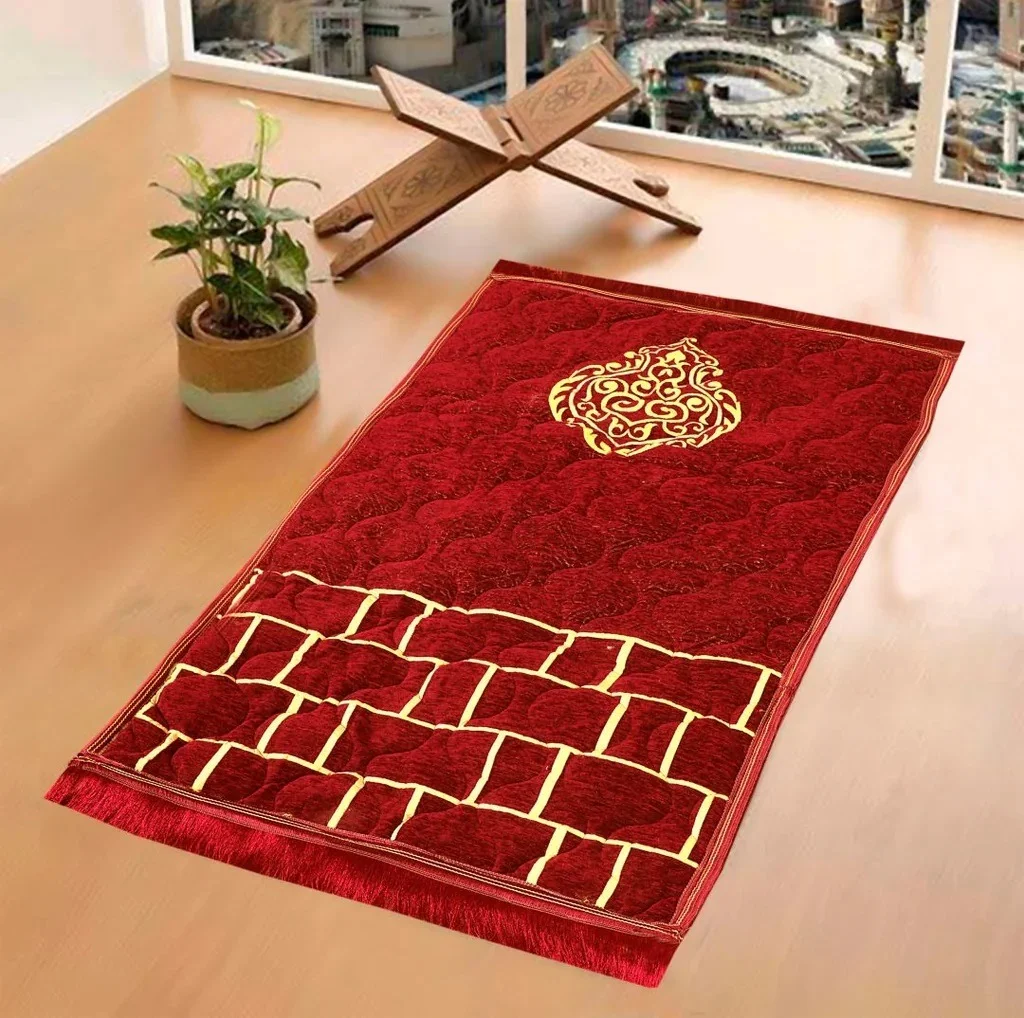
Raschel Velvet Prayer Rug | Orthopedic Foam Cushion
How Do You Identify a Fake or Low-Quality Prayer Rug Before Buying?
This is where most buyers lose money — and it’s entirely preventable with the right checklist.
Red flags for low-quality prayer rugs:
- No GSM or pile density mentioned in the product listing. Legitimate sellers disclose this.
- Photos without texture close-ups. Blurry or single-angle photos hide thin pile.
- Price under Rs. 500 for “velvet.” True velvet with adequate density costs more to manufacture.
- No mention of backing material. Cheap rugs use cardboard-thin non-woven fabric backing that folds and warps within weeks.
- Synthetic smell that doesn’t fade. Cheap polyester and dye chemicals retain odor — a sign of low-grade raw materials.
What to do when buying online:
- Request a close-up photo of the backing from the seller.
- Ask specifically: “Is this machine-washable without color bleed?”
- Check if the seller lists fabric composition (velvet, 100% polyester, acrylic blend, etc.).
- For orders above Rs. 1,500, always choose COD until you’ve verified the seller.
Pro Tip: Legitimate Pakistani prayer rug sellers will always confirm the rug’s size in centimeters, not just “standard size.” If a seller can’t confirm exact dimensions, that’s a warning sign.
What’s the Right Price to Pay for a Prayer Rug in Pakistan in 2026?
Price anchoring in this category is all over the place — and sellers know it. Here’s what you should actually expect to pay for genuine quality.
Budget Tier (Rs. 350–900): Flat-woven cotton or thin polyester. Fine for travel or occasional use. Not for daily household prayer. Color fading within 3–6 months is common at this price point.
Mid-Range Tier (Rs. 900–2,500): Where most quality velvet prayer rugs live. At this range, you can find 400+ GSM velvet with proper latex backing and colorfast printing. This is the sweet spot for most Pakistani households. Buying a velvet prayer rug online in this range from reputable stores delivers strong value.
Premium Tier (Rs. 2,500–5,000): Hand-tufted or machine-made wool blends, thicker pile, richer embroidery. Ideal for gifting (Eid, Hajj, Umrah returns) or long-term personal use.
Luxury / Artisan Tier (Rs. 5,000–8,500+): Hand-knotted pure wool, Persian-inspired patterns, woven in Lahore or imported from Turkey and Iran. These are heirloom-quality pieces.
A 2025 inflation report by the State Bank of Pakistan noted that textile product prices rose 18–22% between 2023 and 2025 — meaning a prayer rug that cost Rs. 800 two years ago now reasonably costs Rs. 950–1,000. Factor this into your budget expectations.
How to Care for Your Prayer Rug So It Lasts for Years
A quality prayer rug Pakistan buyers invest in deserves proper maintenance. The right care routine extends lifespan by 2–3x.
For Velvet Rugs:
- Shake out daily; vacuum on low suction weekly.
- Spot clean with mild soap and cold water only.
- Never machine wash velvet unless the label explicitly states it’s safe.
- Air dry flat — never hang, as this warps the backing.
- Rotate every 3 months to distribute wear evenly.
For Wool Rugs:
- Dry cleaning is strongly preferred. Water loosens hand-knotted weaves.
- Beat gently to remove dust (never beat aggressively — this damages pile roots).
- Store rolled, never folded. Fold lines become permanent creases in wool.
- Moth protection is essential — cedar blocks or lavender sachets work well.
For Cotton Rugs:
- Machine wash on gentle cycle, cold water, mild detergent.
- Tumble dry low or air dry flat.
- Iron on medium heat if needed — cotton tolerates this well.
How Often Should You Replace Your Prayer Rug? With proper care, a mid-range velvet rug should last 2–3 years of daily use. Wool lasts 8–15 years. Cotton, 3–5 years. If the pile is flattened beyond recovery, the backing has warped, or colors have faded significantly, it’s time to replace — not just for aesthetics, but for the cleanliness standards of salah.
Conclusion
Choosing the right prayer rug in Pakistan isn’t complicated — once you know what to look for. Here are your four key takeaways:
- Material determines lifespan. Wool lasts longest; velvet offers the best comfort-to-price ratio; cotton wins on washability.
- Pile density and backing quality matter more than surface appearance. A beautiful rug with a cheap backing will fail in months.
- The Rs. 900–2,500 range is the sweet spot for daily-use quality in 2026, accounting for current textile inflation.
- Buy from sellers who disclose specifications — GSM, dimensions, material composition. Vague listings hide quality issues.
Whether you’re replacing a worn-out janamaz or buying a thoughtful gift for Eid, the right prayer rug Pakistan offers are genuinely excellent — you just need to know where to look and what questions to ask.
Ready to find yours? Browse PakMarkaz’s curated janamaz collection — each listing includes material specs, size confirmation, and customer photos so you can buy with confidence.
Related reads you’ll find useful:
- How to Choose the Right Islamic Gift for Eid 2026
- Best Tasbeeh Counters & Prayer Accessories in Pakistan
- Hajj & Umrah Preparation Checklist: What to Pack
FAQs
Q1: What is the best material for a prayer rug in Pakistan?
Wool is the most durable material for a prayer rug Pakistan buyers use daily, lasting 8–15 years with care. Velvet offers superior softness at mid-range prices. For easy washing and hygiene, cotton is the best choice — especially for families with young children who use the janamaz frequently.
Q2: Where can I buy a velvet prayer rug online in Pakistan?
You can buy a velvet prayer rug online through PakMarkaz, Daraz.pk, and Instagram-based boutiques. PakMarkaz offers category-specific curation with material specs. On Daraz, filter for “Daraz Fulfilled” listings. Always confirm GSM rating, dimensions in centimeters, and whether the seller offers cash on delivery before purchasing.
Q3: How much does a good prayer rug cost in Pakistan in 2026?
A good-quality prayer rug in Pakistan costs between Rs. 900 and Rs. 2,500 for daily use in 2026. Budget options start at Rs. 350 but compromise on durability. Premium wool or hand-tufted rugs range from Rs. 2,500 to Rs. 8,500. State Bank inflation data shows textile prices rose ~20% between 2023 and 2025.
Q4: How do I know if a prayer rug is good quality before buying online?
Check for GSM rating (400+ for quality velvet), exact dimensions in centimeters, backing material type, and machine-washability information. Avoid listings with no texture close-ups or vague descriptions. Ask the seller directly for backing photos and fabric composition. Customer review photos — not just star ratings — are your most reliable quality signal.
Q5: What size should a standard prayer rug be in Pakistan?
A standard adult prayer rug in Pakistan measures 60 cm × 110 cm. XL options run 70 cm × 120 cm for additional knee and forehead space. Children’s janamaz are typically 45 cm × 75 cm. Always confirm measurements in centimeters with the seller — online listings sometimes exaggerate size through camera angles.
Q6: Can I machine wash a velvet prayer rug?
Most velvet prayer rugs should not be machine washed unless the label explicitly states it’s safe. Machine washing loosens the pile and warps latex or foam backing. Spot clean with cold water and mild soap for stains. For full cleaning, professional dry cleaning is recommended for velvet rugs above Rs. 1,500 in value.
Q7: Which Pakistani cities are known for producing quality prayer rugs?
Lahore and Karachi are Pakistan’s primary prayer rug sourcing hubs. Lahore’s Liberty Market and Anarkali Bazaar stock hand-tufted wool and high-pile velvet janamaz. Karachi’s Bohri Bazaar carries Turkish-inspired and locally woven options. Faisalabad’s textile mills supply cotton flat-weave janamaz widely sold across Pakistan’s e-commerce platforms.
